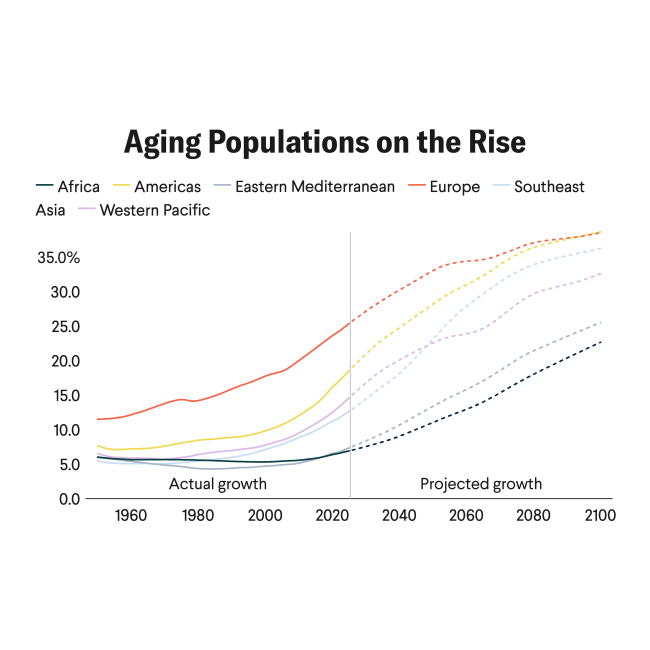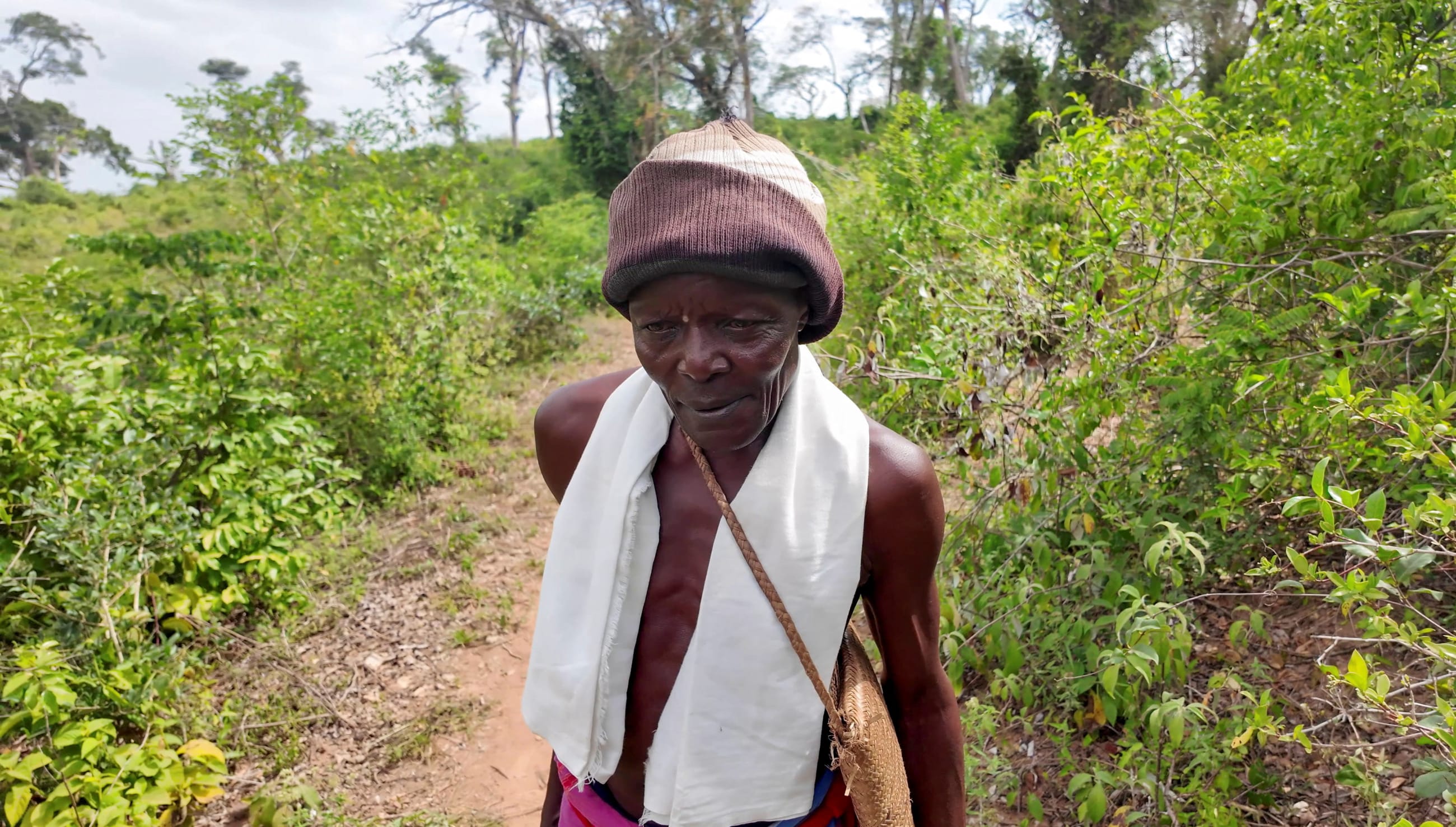
Africa will sit at the center of population-aging trends over the next several decades, as the number of people age 60 and older (60+ population) in the region is projected to grow by 216% between 2020 and 2050.
In Kenya, the 60+ population is anticipated to grow from 2.6 to 10.7 million, a four-fold increase in just 30 years. Latin America and Asia, the next fastest-growing regions, will see their 60+ population increase by 122 and 114%, respectively. In comparison, Europe can expect a relatively modest 29% growth. These projections illustrate how the nexus of population aging is shifting to low- and middle-income countries (LMICs).
Despite these projections, work done for the Longitudinal Study of Health and Ageing in Kenya (LOSHAK) demonstrates that, all too often, the dominant tools to assess the health and well-being of older adults are best suited to Westerners with access to amenities such as electricity and who have high levels of literacy. The project's research shows that "standard" approaches often aren't measuring people's health but rather their Western education. To ensure that data accurately represents local contexts, researchers should reimagine the data collection that informs national aging policies, working closely with communities to capture unique features of different cultures and languages.
The Clock That Ticks Differently
In Western cognitive testing, participants are commonly asked to draw a clock face depicting a specific time of day. This test aims to assess the integration of language comprehension, visuospatial ability, attention, and executive function. It's frequently used as part of a battery of tests on cognitive health and dementia. However, as seen in LOSHAK's pilot study, what works in one part of the world doesn't always translate to another.
The Swahili day begins at sunrise instead of midnight. This has important implications for how people talk about time. In Swahili, saa moja refers to 7 a.m., which translates to one o'clock since the day begins at 6 a.m.—the time of sunrise on the equator. Someone who correctly understands and depicts the time in Swahili by drawing the clock hands pointing to one o'clock would appear to have failed by Western scoring criteria, when in reality their depiction indicates good cognitive function. In a setting like rural Kilifi, Kenya, a clock-drawing test therefore isn't only challenging to administer but can be fundamentally misleading when local linguistic and cultural norms aren't understood.
Along these lines, tests of orientation to time and place tend to use the Western calendar and postal addresses. But these too may fail in contexts where people don't routinely rely on the Gregorian calendar or street names and numbers.
What works in one part of the world doesn't always translate to another
In other cases, such as when participants are asked to name all the animals they can think of in one minute, memory and cognitive function may be hidden behind language barriers. In the LOSHAK pilot, a simple but unique solution was adopted to address this. Participants were allowed to switch between Swahili, Giriama, and English, naming each animal in the language that was most familiar. Interviewers maintained a WhatsApp group so that they could consult with one another and identify animals across languages.
A formal but flexible open-access framework for measurement contextualization could help reshape how aging research is carried out in LMICs. Currently, contextualization is a mostly reactive pursuit. When researchers encounter something unexpected, they respond, striking an item from their survey or tweaking it to better target their study population. As the urgency to understand aging in LMICs mounts, more deliberate proactive approaches are needed. A framework could provide a structured approach to guide teams in developing and evaluating measurement tools. A key part of this process is localization, and it should include researchers and would-be participants who are deeply familiar with local cultures and languages.
Localization, adaptation, and a framework for aging research in Kenya and other LMICs are key steps to centering agency in population aging research, and considerable work is needed to make this a reality, including community codesign, African authorship, and local development of measurement tools.
LOSHAK, which is funded by the U.S. National Institutes of Health (NIH), is part of a global network of harmonized studies on later-life health, aging, and economics led by scholars from around the world. This network creates tremendous opportunities to conduct cross-national research using comparable datasets to understand, for example, the influence of diverse policies, social contexts, and health systems on aging outcomes. It also creates an imperative to get measurements right.
Researchers cannot import Western tools to LMICs without thoughtful cultural, social, and linguistic adaptation. In places where illiteracy and innumeracy are common, and non-Western cultural norms prevail, there is a high risk of mistaking cognitive function for familiarity with Western education. These principles apply not only in LMICs but also for getting measurement right among minority populations in the West.
Data for Healthy Aging and Longevity
In 2050, 22% of the world's population will be 60 or older, compared to just 14% in 2022. Large and rapid shifts in a country's demographics demand policy-level attention to create environments where older people can live fulfilling lives and contribute meaningfully to their communities. Policies should address resources such as pensions, age-friendly workplaces, social protection, and access to resources, health care, and caregiving, among other considerations.
To improve the lives and well-being of older adults, the UN envisioned the Decade of Healthy Ageing (2021–30) to catalyze governmental and civil society action on these policies. Yet, most planning has occurred in East Asia, North America, and Western and Northern Europe, despite rapid aging in LMICs.
More than halfway through the decade, only 55% of African countries (compared to 34 of 35 countries in the Americas) have adopted a national strategy on aging. Critically, this figure overstates actual preparedness: where strategies do exist, implementation remains nascent, chronically underfunded, and rarely monitored against defined targets. More troubling, most strategies were developed in the near-absence of robust population-representative data on the health, functional capacity, and social needs of older Africans. Policy built on borrowed evidence risks fundamental misalignment with lived realities. Progress on this front requires, among other resources, high-quality, longitudinal, population-level data. population-level data.
The World Health Organization and World Bank, among others, recognize that tracking progress and crafting health policy hinges on data availability. But simply making data available is not enough. Language and culture—including etiquette, taboos, and norms—profoundly impact data quality and how people's health is measured.
The Decade of Healthy Ageing offers a rare opportunity to build the evidence infrastructure that aging populations in LMICs deserve. Realizing this opportunity demands sustained investment in locally grounded, culturally adapted, and rigorously harmonized longitudinal platforms—developed with, not merely for, the communities they aim to serve. LOSHAK represents one such effort, and many more are needed.
AUTHOR'S NOTE: This work did not receive any grant funding. The views expressed are the authors' own and do not represent the views of any funding agency or institution.