Tuesday's U.S. midterm election brings a massive shift in Congress's composition for the coming years. Although some results are still pending, namely in Mississippi and Alaska, the Democratic Party has already won 54 seats in the Senate and 253 seats in the House of Representatives. With these election results also come new Democratic governors in Nevada, Texas, Iowa, Georgia, and Ohio. These outcomes have given the Democratic Party a majority in both chambers of Congress and could shift how the Trump administration engages in domestic and international issues.
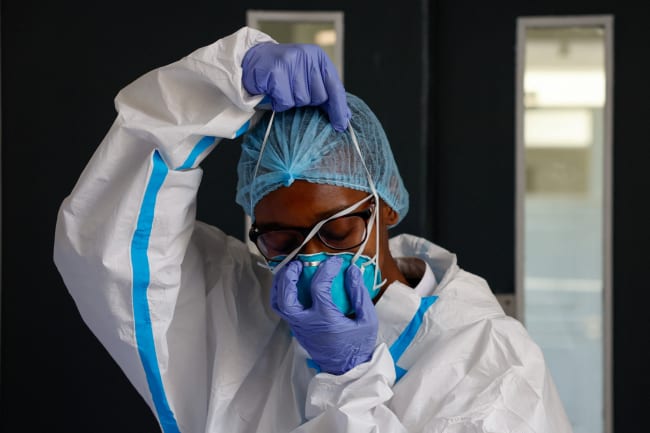
In the realm of global health, the past two years have brought strain to scientific research institutions and foreign aid cuts. The world has witnessed new interactions between the United States and low- and middle-income countries through the America First Global Health Strategy, negotiated through memoranda of understanding (MOUs) that shift aid funding toward jointly financed health agreements. Now, as the United States looks forward, Think Global Health interviewed CFR's Bloomberg Chair in Global Health, Thomas Bollyky, and senior fellows for Global Health Stephanie Psaki, Yanzhong Huang, and Prashant Yadav about what the future might hold for health in the United States and globally.
□ □ □ □ □ □ □ □ □ □ □ □ □ □ □ □□ □ □ □ □ □ □ □ □ □ □ □ □ □ □
Think Global Health: What effects, if any, do you think the U.S. midterm election results will have on global health?
Stephanie Psaki: I would expect the most tangible impact of the election results will be increasedoversight from Congress on how the global health funding will be spent, and how the State Department tracks the effects of shifts in the funding model, such as reporting from governments versus nongovernmental organizations on outcomes. Given the trajectory of the Ebola outbreak in the Democratic Republic of Congo (DRC), I would also expect Congress to start asking more questions about how the administration is responding, including the role of the U.S. Centers for Disease Control and Prevention (CDC) and the White House.
I hope Congress will also start to reengage the Department of Health and Human Services (HHS)—especially CDC—in helping to solve some of the big challenges threatening Americans and the world. Leaders all over the globe turn to CDC's epidemiologists for support and guidance on topics ranging from Ebola to measles to bird flu. American taxpayers are funding CDC, albeit at a lower level, and deserve to fully benefit from the institution's enormous expertise and experience to stay safe.
More broadly, these results will probably accelerate the discussions already happening around the world about what comes next for U.S. foreign policy, and regarding global health engagement specifically. That might not have immediate effects on this administration's policies, but it will begin to lay the groundwork for what comes next.
Tom Bollyky: I will pick up where Stephanie left off: the role that these results will play in accelerating the discussions already happening around the world about what comes next for the United States in global health engagement and development. The perception may be that the dismantling of the U.S. Agency for International Development (USAID), and the reductions and restructuring in U.S. development assistance for health into timebound bilateral agreements, leaves a cleaner slate for an incoming administration in 2029 to set a new course in this sector. These election results will undoubtedly raise the ambition of those planning efforts for newly confident Democrats, and shift the locus of that planning to the U.S. congressional committees responsible for the oversight of the relevant appropriations and agencies.
That might not have immediate effects on this administration's policies, but it will begin to lay the groundwork for what comes next
Stephanie Psaki, CFR senior fellow for Global Health
Yanzhong Huang: Democratic control of Congress will create openings for the partial restoration of USAID funding and functions, though a full revival of the agency is unlikely in the near term. It will also constrain implementation of the America First Global Health Strategy through stronger oversight of bilateral agreements via MOUs, particularly regarding transparency, data-sharing terms, and implementation capacity. Any such changes are likely to be gradual rather than transformative. Further, President Donald Trump still retains veto power through January 2029, and Democrats lack a filibuster-proof Senate majority.
Meanwhile, competition with China, including over biopharmaceuticals, remains a shared priority across parties. Preexisting bipartisan pressure for tighter rules on outbound investment, licensing deals, joint ventures, clinical-trial activity, and supply-chain ties with Chinese biotechnology companies is likely to continue.
Prashant Yadav: I expect there will be continued and perhaps even greater interest in U.S. domestic manufacturing, reducing U.S. dependence on foreign suppliers, and advanced biotechnology. However, legislative proposals and oversight could ask more questions about the role that allied partnerships can play in this regard.
I also expect more stringent congressional oversight to ensure that monies appropriated to global health are disbursed, spent, and implemented. This will also translate into greater calls for transparency and accountability on the bilateral agreements under the America First Global Health Strategy.
But at the same time, we have to set expectations right, especially for health-sector leaders of the countries that are recipients of U.S. government support. The election results and significant changes in the legislative branch will not restore grants to earlier levels. The election will not bring back the old way of doing business, and it will not go back to rebuilding U.S. global health staffing to earlier levels. Those decisions by the executive branch are here to stay in the medium to long term, and many countries have already adapted their financing and delivery systems for the new way of government-to-government funding.
New leadership at the Global Fund will also have to engage with a more bipartisan legislative group regarding U.S. support to the Global Fund, issues related to global health architecture reform, and the U.S. global health engagement model.
Think Global Health: What are the likely implications of the midterm elections for health policy and research in the U.S. itself, particularly with the election of health professionals in multiple states?
Stephanie Psaki: Millions of Americans are expected to lose their health insurance beginning in early 2027 because of the One Big Beautiful Bill Act (OBBBA) restrictions on Medicaid and rollback of the Obamacare tax credits. This is a public-health and economic challenge facing Americans as well as newly elected leaders. Some states may be able to fill the gaps in lost federal funding, while others may not be able to do so. Federal and state leaders clearly have a mandate from this election to make health care affordable, so hopefully they will work together to mitigate the risks from OBBBA.
In terms of research, Congress has consistently maintained support for science and research funding in the United States, despite the Trump administration's attempts to cut funding. I would also expect to see more oversight here, however. For example, reports about the loss of top scientists across the U.S. government, and from universities that depend on U.S. government research funding, are very concerning: a 2026 survey with a sample of U.S.-based scientists, including those born in the United States and abroad, found that 75% were considering leaving the United States. Other countries, including Canada, China, and India, are making large investments to attract scientific talent through accelerated immigration paths and financial incentives for their research. This is a major concern for the health of Americans, as well as for the competitiveness of U.S. companies and the country's preparedness for a range of biological threats.
Yanzhong Huang: The midterm elections saw the so-called STEM wave, with a record number of doctors, nurses, scientists, and engineers winning seats. These include Annie Andrews, a pediatrician, Abdul El-Sayed, an epidemiologist, and Amy Acton, a physician. This group is expected to scrutinize HHS Secretary Robert F. Kennedy Jr.'s tenure and the Make America Health Again (MAHA) agenda. They are likely to prioritize health-care costs, play a critical role in efforts to reverse or delay recent Medicaid cuts, and restore Affordable Care Act subsidies. They are also expected to increase pressure to restore or stabilize National Institute of Health (NIH) and CDC budgets, limit political interference in grants, and protect vaccine-related research and public-health infrastructure.
Prashant Yadav: New congressional leaders from both parties who have backgrounds in public health, medicine, or related health areas will press to bring more predictability and clarity in the allocation and disbursement of medical and health research funding to NIH, Biomedical Advanced Research and Development Authority (BARDA), Advanced Research Projects Agency for Health (ARPA-H), Administration for Strategic Preparedness and Response (ASPR), and the Food and Drug Administration (FDA). They will also make serious asks for more science-based, credible decisions by HHS and the agencies under it. While the bulk of these research monies and agency decisions serve the U.S. domestic health agenda, they also have significant implications for global health, such as funding for research on malaria, HIV, tuberculosis, other infectious diseases, vaccines, and manufacturing platforms for medical technologies. Also, the world looks up to the U.S. FDA as the more advanced health-technology regulator—these have been some of the most important contributions of the United States to the field of global and international health.
EDITOR'S NOTE: Responses were lightly edited based on interviews conducted via email.