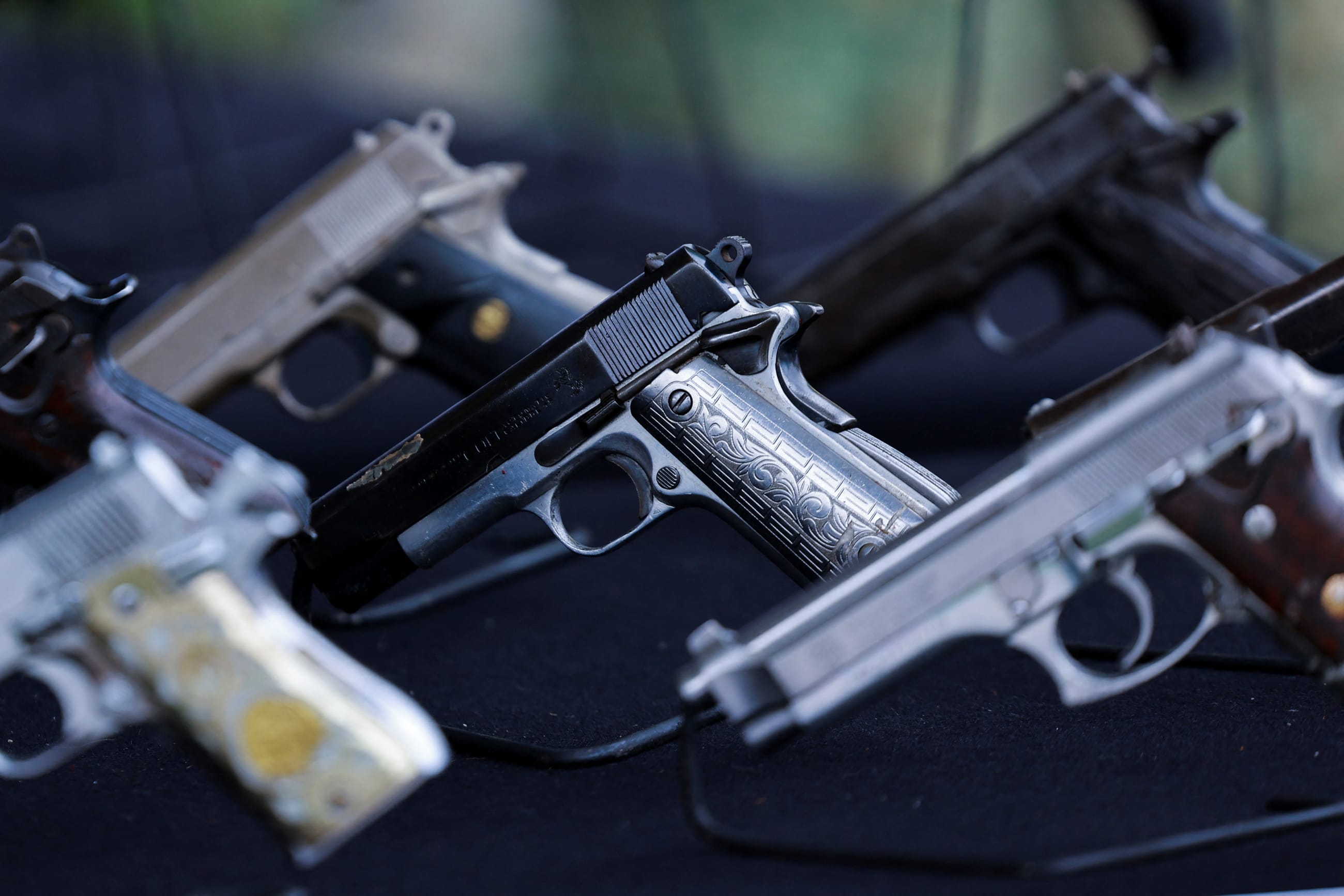
From Australia's Bondi Beach to Uvalde in the United States, recent mass shootings have given visibility to the global challenge of firearm violence. Over the last decade, firearms have claimed an estimated 2.6 million lives and injured twice that number, many of whom experience lifelong physical and mental health sequelae. Firearm violence is unique in its multilevel burden of disease. It has an outsized scope relative to the broader social impacts of community destabilization, widespread fear, forced migration, and overwhelmed health systems.
Despite the devastating magnitude of global firearm violence, the global health community has remained largely silent on the subject. A new report, Tracking the World Health Organization's Attention to Gun Violence, 2000–2025, launched on February 10, 2026, by the Global Coalition for WHO Action on Gun Violence (Global Action), provides a compelling case and a comprehensive roadmap for the World Health Organization (WHO) and its states to engage in this critical but neglected area of global health.
Global Gun Violence Epidemic
In 2023, the United States, Brazil, Colombia, India, Mexico, and Venezuela accounted for nearly 60% of these deaths. Firearm death rates vary widely among countries, depending on national policies, gun ownership, civil conflict, economics, demographics, history, and other factors. Globally, homicides account for 70% of firearm deaths and suicides for 25%. In the Caribbean and Latin America, three-quarters of firearm deaths are homicides; in Europe, however, more than three-quarters are suicides.
In a growing number of countries, firearms and bullets are "the leading cause of death for children and adolescents (ages 1–19), surpassing motor vehicle crashes, cancers, and drug overdose[s]." Particularly among boys younger than 19 in countries such as Brazil, Colombia, Mexico, and the United States, the most common cause of death is a firearm-related bullet injury. The presence of a firearm in the home makes it 5 times more likely that a woman in a domestic violence situation will die and three to four times more likely that a youth will die in a suicide attempt than if a firearm were not present.
Firearm-related injuries impose a substantial and largely preventable burden on health systems worldwide. Across countries with high levels of gun violence—such as Brazil, El Salvador, Jamaica, Mexico, and South Africa—emergency and inpatient treatment for gunshot wounds consumes millions of dollars annually, often straining already underresourced public hospitals.
Gun violence can increase poverty by driving people and businesses out of communities, which cyclically leads to further poverty and increased gun crime. Exposure to gun violence also inflicts psychological harm on children and adolescents; regardless of whether these individuals are direct victims or witnesses, exposure frequently results in developmental issues. In a global context, gun violence is one of the main drivers of forced migration to the United States from communities in the Caribbean, Central America, and Mexico.
Firearm Violence Declines When Leaders Choose to Act
In the face of such challenges, countries and entire regions have demonstrated that, when national leadership has chosen to act, success is notable in reducing preventable gun-related homicides and suicides.
The European Union (EU), through a series of directives starting in 1991, developed strict firearm regulations, which have kept gun-related mortality rates among the lowest in the world. The positive results of firearm legislation on homicide, suicide, and femicide have been demonstrated in studies from Austria, Denmark, Montenegro, Norway, Switzerland, and elsewhere in the EU.
Policies include provisions for background checks, mental health checks, firearm acquisition processes, and safe storage regulations. Austria's 1997 firearms law, which followed the EU directive with strict changes in the acquisition and possession of firearms, led to declines of 3.8 to 2.4 per 100,000 people in firearm suicides and 0.4 to 0.1 per 100,000 in firearm homicides. The United Kingdom's Firearms Act Amendment of 1997, which followed the 1996 Dunblane school shooting, effectively banned handguns. This and subsequent policies have kept the United Kingdom's firearm homicide and suicide rates among the lowest in the world.
The Australian government, after a 1996 gun shooting that left 35 dead, rapidly implemented a combination of reforms that included a large-scale gun buyback funded by a temporary levy, bans on specific rapid-fire weapons, and the registration of all guns and the licensing of all firearm holders. Importantly, these reforms were framed as a package under a new National Firearms Agreement (NFA) [PDF] rather than piecemeal and were centered on a public safety approach. The opening statement of the NFA [PDF] affirms "that firearms possession and use is a privilege that is conditional on the overriding need to ensure public safety." These reforms had a substantial and positive effect on gun violence in Australia. Average annual firearm-related mortality declined from 3.6 per 100,000 people between 1979 and 1996 to 1.2 per 100,000 between 1997 and 2013. Reductions in firearm suicides and homicides were significant, and no mass shootings of 5 or more people were recorded in the 25 years following the reforms.
The United States has by far the highest gun ownership and firearm mortality rates among high-income countries and among the highest in the world. The right to gun ownership is constitutionally protected, and guns are culturally iconic in ways unique to the United States. Yet its national figures mask the nearly 10-fold differences in firearm mortality rates among states. The 2025 JAMA Summit on Firearms Violence report summarizes the evidence for nearly two dozen specific interventions shown in the United States to reduce homicides, suicides, or firearm harms. These interventions include firearm laws and regulations, community violence interventions, community environmental changes, alcohol policies, social and economic policies, and policing interventions.
The United States has by far the highest gun ownership and firearm mortality rates among high-income countries and among the highest in the world
States with low or decreasing mortality rates used various combinations of these policies. In contrast, states with high or increasing firearm mortality rates have implemented fewer proven interventions. At the same time, they are much more likely to have deployed one or both laws associated with increased firearm deaths: concealed carry and "stand your ground," which allows firearm violence as a first rather than a last resort for self-defense. For example, California, New York, and Washington experienced notable decreases in firearm death rates: 16.2 to 8.6, 13.4 to 5.3, and 55.1 to 21.4 per 100,000, respectively. During the same period, Mississippi, Missouri, and New Mexico experienced concerning increases in firearm death rates: 21.1 to 29.6, 16.9 to 24.2, and 16.8 to 27.3 per 100,000, respectively.
In South Africa, which also has high rates of firearm violence, the Firearms Control Act of 2000 tightened licensing, required competency testing, mandated safe storage, strengthened background checks, and facilitated removal of illegal guns. These changes were estimated to have saved 4,585 lives in five South African cities from 2001 to 2005 alone. The policy's enactment led to a steep decline in homicides and femicides over the next decade, reaching a 2011 death rate half that of 2000. Since then, however, relaxed licensing practices, illegal diversion of guns to criminals from police stockpiles, and other enforcement lapses have led gun violence to resurge. Firearm-related homicides increased by 35% between 2021–22 and 2022–23.
In 2012, as Colombia's government turned the tide of Revolutionary Armed Forces of Colombia (FARC) insurgency, officials introduced a city-level firearm-carrying ban for Bogotá and Medellín, which reduced gun-related mortality rates by one-fifth in both cities. Enforcement was intensified during high-risk periods such as weekends, holidays, and election days, and included checkpoints and police searches in higher-risk areas. Firearm-related deaths have since continued to decline from pre-ban rates of more than 35 deaths per 100,000 to just over 20 in recent years. Colombia's experience shows that high-violence countries can improve substantially, especially when urban policy, security reform, and firearm restrictions are combined.
Global Leadership Is Essential to Reducing Global Gun Violence
The experiences of Europe, certain U.S. states, Colombia, and South Africa provide encouraging demonstrations that firearm violence can be reduced when government leaders choose to act. Yet maintaining these gains is an ongoing challenge, even though gun violence continues to increase in too many parts of the world.
In the past, when faced with seemingly overwhelming global health challenges, countries have turned to the World Health Organization. From smallpox eradication to HIV/AIDS containment, tobacco control, and reducing road traffic injuries, success has come through WHO leadership.
WHO treatment guidelines, quality assurance programs, and country support in the early 2000s played a vital role in transforming AIDS from a death sentence to a chronic illness in scores of countries. Global and national action resulting from the 2003 WHO Framework Convention on Tobacco Control ("Tobacco Treaty") had saved an estimated 37 million lives by 2020.
Despite the organization's track record in several areas and in the face of growing global conflict, the WHO has remained largely absent in addressing firearm violence. Global Action, established in October 2025, provides a timely movement of more than 120 organizations across more than 40 countries, whose aim is to mobilize the collective efforts of WHO member states and the global community to address the global burden of disease and societal impact.
In its 2026 report, Global Action argues that the WHO should commit to "proactively advance gun violence prevention and ensure human and financial resources for this critical work." Specific areas in which WHO leadership would have significant outcomes on firearm violence include the following:
- Global shared agenda for reducing gun violence. The WHO is in a unique position to develop an action plan by engaging people directly affected by gun violence, regional and national public health bodies, civil society advocates, firearms researchers, and, most notably, rights advocates, women, children, and other vulnerable populations. The annual World Health Assembly (WHA) provides an ideal forum for national health authority leaders to develop a shared agenda to combat firearm violence, to track progress, and to advance a WHA resolution calling for WHO Action on Firearm Violence. The coalition leaders are actively recruiting member states to begin advancing a WHA resolution.
- Evidence for action. Use the WHO's convening powers to assemble leading gun violence experts to review the global evidence on the effectiveness of prevention measures and develop a global agenda to address research gaps, as it has done in other areas, such as with pandemic responses.
- Support to country and regional action. WHO support would provide a significant boost for country and regional action, including guidelines for national action plans, implementation tools for multipronged gun violence prevention strategies, guidance on gun violence communication, and support in countering gun industry lobbying.
- Firearms marketing code. Aggressive and predatory firearm marketing through social media, video games, television, and films could be addressed through a market code analogous to the one created in response to increasing infant mortality resulting from the deceitful marketing of infant formula. Adopted by the WHO in 1981, the "breast-milk substitutes" code has been put into law by at least 140 countries.
- Monitoring implementation of existing firearms multilateral treaties, protocols, and conventions. In addition to the EU's, various regional intergovernmental collaborations for reducing gun violence have been established, including in the Americas, Africa's Great Lakes and Horn of Africa region, and West Africa. A 2025 seminal report from four leading Caribbean organizations, which lays out the pathway for combating rising firearm homicides, offers an excellent example of action-oriented regional collaboration.
A robust array of effective, evidence-based measures have been shown to reduce firearm harms available to any region or country whose leaders and government and civil society leaders choose to take action. This is the time for a collective, aligned call to action for member states and the WHO to address and reduce global firearm violence.