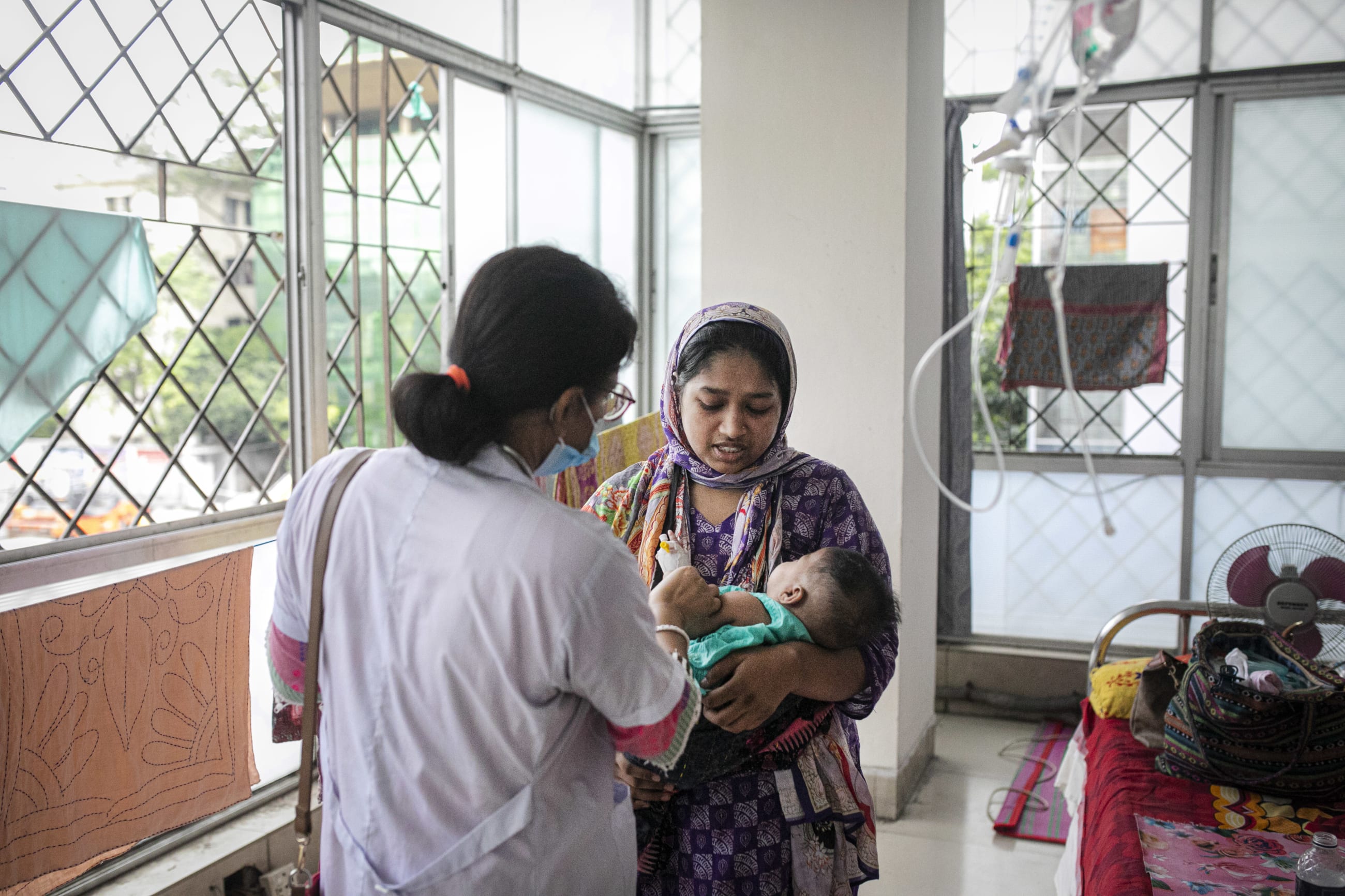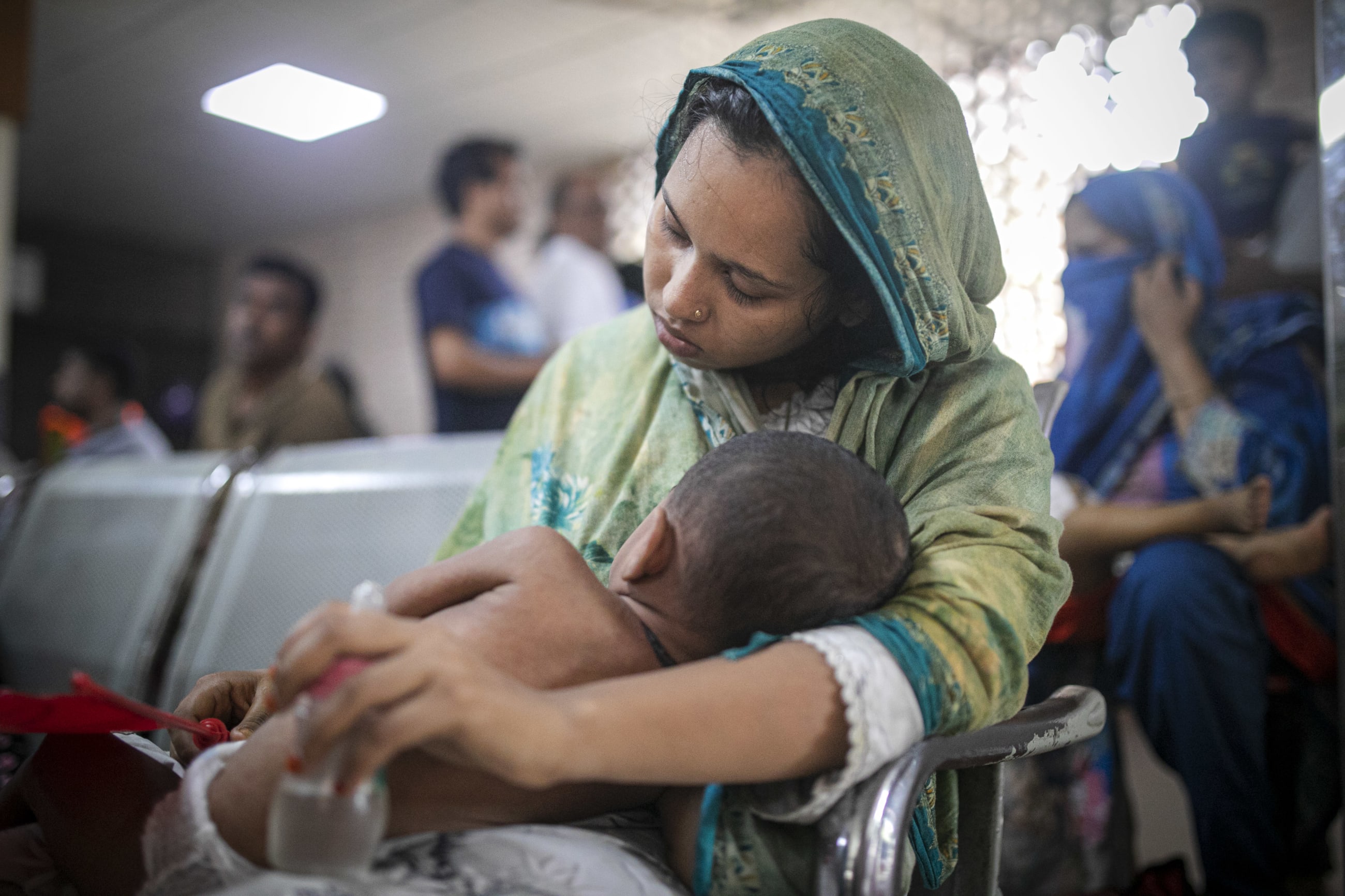
In May, Sharmin Akter sat in the measles ward of Bangladesh's Dhaka Shishu Hospital beside her 7-month-old daughter, who was admitted seven days prior. The previous night, her daughter was struggling to breathe. Although the doctor immediately managed the issue, Akter was terrified. "I have seen a child die in this ward, so I am very afraid. All the children here have measles."
Akter's daughter is part of a massive measles outbreak that has swept across Bangladesh for the past five months. It is currently the world's largest in terms of case count, revealing how frail the country's health security has become. As of August 4, 2026, the Directorate General of Health Services reported that at least 849 children had died from confirmed and suspected measles, and that there were 131,946 suspected cases and 16,531 confirmed infections. Provisional data from the World Health Organization (WHO) reports 42,780 cases, based on monthly surveillance data. The real toll may be higher in rural areas where reporting is weak.
Although Bangladesh was once a measles success story, policy failures dismantled decades of progress, creating the conditions for the explosive 2026 outbreak. For years, Bangladesh relied on a direct procurement system using Gavi-supported channels, managed by the UN Children's Fund (UNICEF), to ensure a stable, reliable supply of doses. But by the end of 2025, the interim government of Bangladesh had made a major change in routine vaccine procurement, contributing to a major drop in vaccination. Aid cuts in 2025 disrupted vaccine infrastructure as well.
Now, the disease is spreading fast, with all of Bangladesh's 64 districts reporting measles transmission, according to a June UN report. Children younger than 5 account for more than 80% of infections. Infants younger than 9 months—too young for routine vaccination—make up nearly one‑third of cases.
"Measles is a test of governance," according to health communications researcher Abu Mohammad Sakil Faizullah. "It shows whether a state can maintain a routine service every week, in every district, for every child. When procurement is delayed, when stock levels are not protected, when surveillance warnings are not acted upon quickly, and when communication with the public is not clear, the virus finds those gaps."
Bangladesh's Slipping Vaccination Rates
Bangladesh was praised as a public health success for decades. Between 2021 and 2025, the country reported roughly 100 to 300 cases annually, and elimination seemed within reach. The country's Expanded Program on Immunization (EPI) reached children in remote villages, built trust with families, and kept measles under control; coverage rates often matched or even surpassed those of richer countries.
But behind these successes, the system was weak. According to WHO, at least 95% of children need to be vaccinated to stop the spread of measles. According to official WHO/UNICEF data for 2023 to 2025, Bangladesh missed this target, falling below 90% coverage for both first and second doses.
Atiqul Islam, a child specialist and professor at Bangladesh Shishu Hospital, said, "Our herd immunity was once at 95%, but it fell in the last two to three years. Because of that drop, the infection spread faster, and more children were left unprotected."
Some government officials blamed Bangladesh's measles disaster on the COVID‑19 pandemic, in 2020, when lockdowns disrupted health systems everywhere, including in Bangladesh. The protection built over many years was also broken apart by policy gaps, slow bureaucracy, and supply-chain failures that left vaccine stocks dangerously low.
Although the global pandemic caused a delay in vaccination, according to independent experts, to blame only 2020 is to ignore the specific policy failures of the past two years. Whereas other countries were able to restore their regular immunization schedules by 2023, the 2025 aid freeze in Bangladesh and the cancellation of vital campaigns left Bangladesh's system in shambles.
After Bangladesh's former Prime Minister Sheikh Hasina was ousted in 2024 following student-led protests, the interim government led by Muhammad Yunus introduced reforms in 2025 including shifting away from UNICEF's procurement system toward an open bidding process. Officials said the move was designed to establish a more transparent, rules-based system and reduce the perception of favoritism or reliance on external agencies. By moving to a competitive bidding process, the government intended to ensure that vaccine procurement was managed through the national budget process, a change they argued would strengthen institutional accountability.
According to UNICEF, however, this system not appropriate for urgent vaccine needs because it caused delays and disrupted routine immunization. The organization sent multiple letters and held at least 10 meetings with officials advocating to restart the procurement process, but delays continued. Bangladesh usually procures about 70 million doses annually, but only 17.8 million doses were secured in 2025 via UNICEF's prefinancing mechanism, leaving central warehouses nearly empty. A nationwide campaign [PDF] planned for late 2024 was postponed and ultimately canceled, leaving millions of toddlers unprotected.
Faced with a resulting surge in measles cases and deaths, the cabinet approved a return to direct procurement through UNICEF in June 2026 to stabilize the supply chain. This was the latest move in an emergency mass-vaccination drive to control the measles outbreak that began on April 5, 2026, in 30 high-risk regions, and expanded to a phased nationwide rollout on April 20, targeting 18 million children age 6 months to 5 years.
However, Bangladesh's vaccine campaign has still not been able to slow the outbreak, partly because of logistical challenges and lack of infrastructure.
Nazrul Islam, a health worker from rural Bangladesh, said, "The measles vaccine is pretty sensitive. During hot temperatures, it may lose its strength. The measles vaccines must be stored between 2°C and 8°C temperature, but when we are operating, the temperature of that place's environment is over 30°C. There is no permanent vaccine center; we vaccinate children under trees, in people's yards, or on Madrassa verandas. It really needs a proper EPI center."
Funding Cuts Further Stall Vaccination
USAID once played a central role in Bangladesh's health and development, funding vaccines, clean water, and maternal care. In fiscal year 2024, support stood at $371 million. In January 2025, the U.S. government froze aid, suspending more than 100 projects worth $550 million. The freeze cut off jobs for thousands and left hospitals, schools, and villages without support.
The result immediately impacted immunization by disrupting the local logistics network that kept vaccines safe, and cutting pay for more than 1,000 health professionals and many community workers. These were the people who ran clinics, tracked which children had missed which doses, and conducted door-to-door outreach. Given that funding for child protection was reduced by 36%, programs specifically designed to find "zero-dose" children in urban and rural remote areas were forced to close.
Sakil Faizullah said, "The first lesson is that routine immunization must be protected during political transitions. Governments may change, ministers may change, procurement rules may change, but child vaccination cannot be paused while institutions debate procedure."