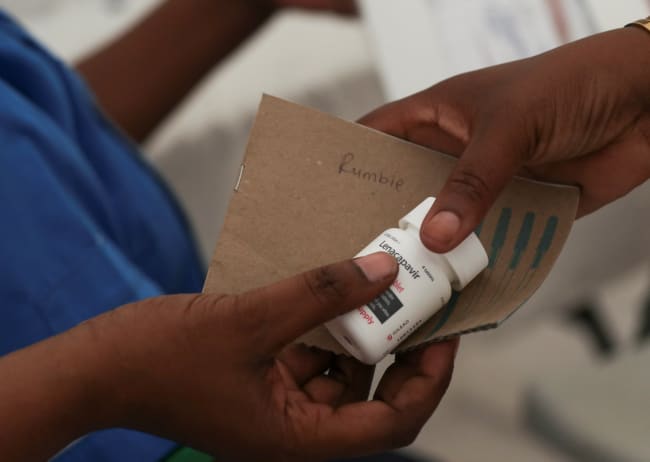
In April 2026, the U.S. State Department and the Global Fund announced a plan to scale up global distribution of lenacapavir (LEN), a twice-yearly injection shown to offer nearly complete protection against HIV in some populations. LEN is one of the most exciting prevention options developed thus far, offering the potential to truly bend the curve of the epidemic if scaled quickly and equitably.
Yet the HIV epidemic cannot end with LEN alone. Historically, vaccination is the only tool that has provided a durable end to any epidemic. LEN requires semiannual clinic visits to maintain protection, whereas a vaccine could provide longer-lasting immunity for at least a year and potentially longer, depending on the vaccines in development. In addition, an HIV vaccine could be distributed widely through existing immunization programs to entire populations, not just those who perceive their risk. LEN's effectiveness could also be affected by the rare emergence of drug resistance due to HIV's capacity for mutations.
Historically, vaccination is the only tool that has provided a durable end to any epidemic
Vaccine science is cumulative: today's breakthroughs depend on decades of investment. The incredible progress the world has witnessed over the last four and a half decades to slow the HIV epidemic, from antiretroviral therapy to pre-exposure prophylaxis (PrEP) including long-acting injectables like LEN, has been built on basic research, clinical trial infrastructure, global coordination, and community engagement and leadership. Ending the epidemic will require all of these elements.
"LEN didn't emerge overnight," Wes Sundquist, of the University of Utah, whose scientific discoveries led to the development of LEN, told AVAC last year. "LEN is the result of patient, persistent basic science—of believing we could understand a virus deeply enough to target it effectively."
Despite the need for sustained investment in HIV science, the Trump administration continues to dismantle this powerful piece of public health infrastructure. The president's fiscal year 2027 budget request proposes a $5 billion budget cut for the National Institutes of Health (NIH), which has historically funded nearly 80% of publicly funded vaccine research globally and is the single largest funder of HIV vaccine research worldwide.
The president's current budget request includes a 28% cut to the National Institute of Allergy and Infectious Diseases (NIAID) and a nearly $600 million reduction to the Office of AIDS Research (OAR), which coordinates HIV research across the NIH. The accompanying Congressional Budget Justification (CBJ) issued by the NIH offers no explicit mention of HIV vaccine research and indicates a shift away from basic science and vaccine development. It also signals the potential for a dramatic shift of the NIH's budget and priorities away from basic and clinical science toward implementation science, with an emphasis on how best to use existing tools, including LEN, to end the HIV epidemic in the United States and limit international research collaborations.
Research and aid cuts have undercut the entire HIV response, from basic research to global delivery, leaving fewer people to access prevention and treatment, according to the most recent release of PEPFAR results data. Funding cuts erode the foundations of vaccine science, undermining research institutions, disrupting long-standing programs, fueling confusion and mistrust, and threatening the health of future generations.
Developing an HIV Vaccine
HIV vaccine research today is in a new era focused on early-stage, iterative discovery approaches designed to induce broadly neutralizing antibodies (bNAbs) and T-cell responses. These strategies represent a scientifically sophisticated path forward and consensus on the intricate science needed to successfully develop a vaccine. Earlier this month, the annual meeting of the NIAID-funded HIV Vaccine Trials Network (HVTN) highlighted incremental advancements—especially around the bNAb-inducing approach—that have taken years of development. The next several years will be critical to advancing these approaches to work toward a viable vaccine candidate.
As leading South African scientist Penny Moore recently told National Public Radio, "We need to get to the point where we are finally ahead of the virus… I'm not saying we're around the corner. It's a tough virus, but I feel like we're closer than we have ever been."
Efforts of the HVTN, the NIAID-funded Centers for HIV/AIDS Vaccine Development, which fuels the basic science behind vaccine candidates, and other HIV vaccine research groups represent "big science": large, coordinated efforts to advance a scientific agenda too difficult to be accomplished by any one grant, group, or company. If this scientific enterprise is not sustained, the world will lose years of knowledge gained—and dollars invested—for one of the most formidable scientific challenges of our time.
Maintaining Scientific Momentum
It is unlikely that the historic levels of funding for HIV research and implementation will return. This reality makes strategic prioritization more important than ever. In AVAC and partners' People's Research Agenda, the organization calls for a balanced portfolio across the spectrum of early, basic science, clinical trials, and implementation, recognizing that having the greatest impact on the epidemic will require sustained investments across the full continuum of innovation, discovery, and delivery. No single intervention will ever be a "silver bullet," and the risks of overinvesting in areas where outcomes and lasting success are still unknown—such as relying solely on LEN for PrEP—is real.
LEN shows what science can achieve when the world invests for the long term. Weakening fundamental scientific infrastructure now risks slowing progress well beyond HIV to other disease areas, for pandemic preparedness, routine immunization, and other emerging global health threats. If HIV prevention research and development is not restored, the world won't just lose the next LEN—it could lose the next cancer therapy, the next Alzheimer's breakthrough, or the next cancer cure.
At a moment when scientific progress is advancing, advocates, researchers, policymakers, and communities should push back against politically motivated, fringe, antivaccine sentiments that threaten decades of investment to develop the tool that would finally break the back of the epidemic.