As leaders gather in New York City for Climate Week and the UN General Assembly, they will discuss climate action, adaptation finance, and a "just transition." But one question should be at the center of those conversations: who is visible in the data used to decide who gets protected?
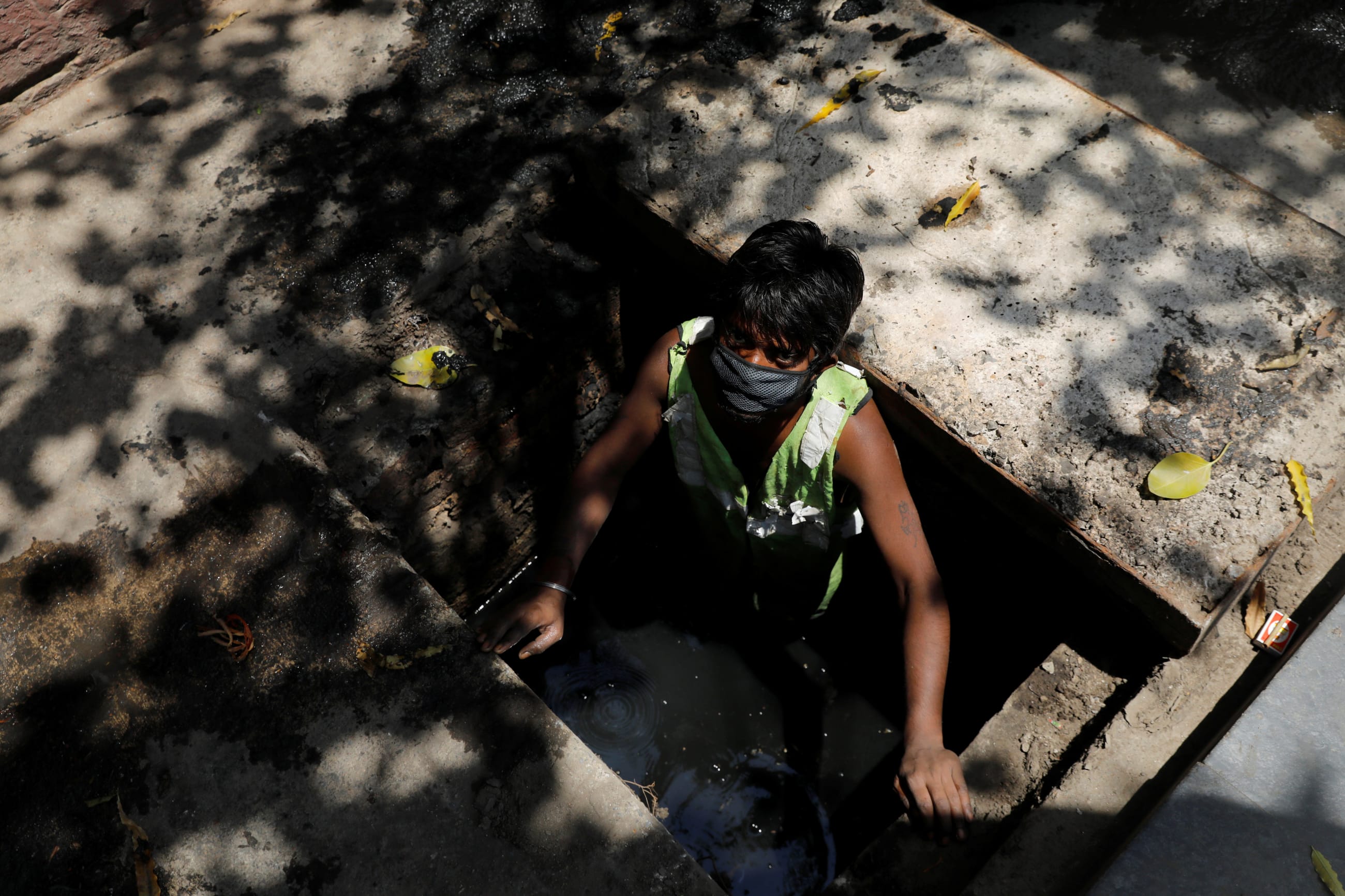
In India, surveys often miss Dalit sanitation workers, the people who clean sewers and septic tanks by hand, frequently in extreme heat and amid toxic gases. Although India banned "manual scavenging," the practice of physically removing human excreta, India still has millions of sanitation workers. The country's supreme court accused 15 states of contempt of court for failing to enforce the bans in July 2026.
Manual scavenging is a hazardous job that killed roughly 400 workers [PDF] from 2019 to 2023, according to a report published by the Indian government, and it is made even more dangerous by extreme heat. Toxic gases that accumulate in sewers, including hydrogen sulfide and methane, can cause poisoning and suffocation in closed spaces. These gases form when wastewater sits in warm, oxygen-poor pipes and tanks, exactly the kinds of conditions that are becoming more common in hotter summers. As heatwaves intensify and a developing El Niño is expected to raise the risk of further extreme heat and disrupt rainfall patterns, governments, city officials, and donors in India are under pressure to protect people, yet the country's current climate response frequently omits the very people doing the most dangerous jobs.
Many of India's sanitation workers still belong to Dalit communities: groups pushed for generations into jobs labeled "unclean," such as handling garbage and human waste, because of caste rules about purity and pollution. According to one study, marginalized caste groups face 25% to 150% higher occupational heat exposure than dominant-caste groups, even when education, income, and location are similar. The Dalit community is among India's most vulnerable groups, yet the country's climate action plans do not track caste, thereby failing to channel resources to the most marginalized people in Indian society.
According to one study, marginalized caste groups face 25% to 150% higher occupational heat exposure than dominant-caste groups, even when education, income, and location are similar.
The caste system in India is a graded form of inequality enforced through centuries of occupational segregation and spatial exclusion, determining who stands in the sun, who breathes toxic air, and who can afford to stop working when their body fails. Dalits have historically been denied land, education, and safe work; even when laws prohibit discrimination, these patterns persist. The practice of manual scavenging continues because enforcement of the ban is weak, local governments rely on informal labor, and caste norms still mark Dalits as the people who have always done this work.
Empirical data now shows just how large those caste-based differences in exposure actually are.
Government Systems Are Missing Marginalized Castes
To decide where to channel scarce resources such as early warning systems, health investments, and cooling centers, policymakers and donors rely on risk scorecards: tools that rank every district in a country by how "vulnerable" it is to climate harm. But these risk scorecards do not track caste. In India, for example, a think tank has assessed [PDF] all 734 districts using 35 indicators spanning temperature exposure trends, population density, and access to health-care, producing a heat-risk ranking that policymakers and planners use to guide direct adaptation decisions. It is one of the most comprehensive tools of its kind. A district can score "moderately vulnerable" on a scorecard and still be home to thousands of Dalit sanitation workers cleaning open sewers in extreme heat, people who will never appear as a distinct, high-risk group because the scorecard was never designed to ask about caste, occupation, or historical exclusion.
India's climate-health vulnerability assessments [PDF], tools that shape where health and adaptation resources go, include a national framework developed by a consortium of Indian science institutions for the Department of Science and Technology. The framework maps vulnerability across every state and union territory using socioeconomic indicators such as income, health-care availability, and access to infrastructure. Although these are sensible proxies, they are constructed as population averages, which effectively treat poor households as interchangeable units and leave unexamined the structural reasons why particular communities are poor, live where they do, or perform specific kinds of work. When a heat action plan describes its target population as "informal workers" or "slum dwellers," it is being evasive. In much of India, caste determines who becomes an informal worker.
A Different Kind of Measurement
There is a reasonable concern that official measurement can harden the very caste labels India should ultimately leave behind. Critics of a caste census argue that the state should move beyond caste classification, and that public policy should focus on income or socioeconomic disadvantage instead of inherited social identity. India stopped counting caste in its national census after independence, partly in the hope that these distinctions would fade. However, caste continues to shape work, housing, education, health, and access to public services. What would it mean to build vulnerability metrics that name caste instead of erase it?
Three principles follow from both the evidence and the demands of structural justice. First, caste should be an explicit variable instead of a proxy, residual, or implication in climate policies and state climate action plans. The Indian caste census now underway, the first in nearly a century, gives the country a chance to use detailed caste data to see which communities face the greatest climate and health risks, and then channel adaptation money and support directly to them instead of relying on caste-neutral averages. If India seizes this opportunity to direct climate finance based on verified caste-based exposure gaps, it would set a precedent no other Global South country has attempted. This would matter not only for India but also for other societies with entrenched caste and castelike hierarchies from Nepal, Bangladesh, Pakistan, and Sri Lanka in South Asia to caste-structured communities in parts of West [PDF] and East Africa, where climate risks also fall hardest on those relegated to "low-status" work and land.
Second, researchers and policymakers need to examine the gaps between groups, not just overall averages. Instead of measuring health-care access as a district-level average, we should track caste gaps in health-care access. For example, hypothetically, these differences could look like 80% of dominant-caste households in a district being able to reach a clinic within 30 minutes, but only 40% of Dalit households able do the same. That kind of measure shows the difference between groups in the same geography instead of hiding it behind a single number. It asks not just "who is vulnerable?" but "who made them vulnerable, and how?"
Third, the people living with heat everyday need to help shape how governments measure it. Dalit sanitation workers are working inside systems where gas levels fluctuate with the diurnal flow pattern of sewers, spiking when flow drops and bacteria‑coated pipe walls are exposed to the air, when the fumes get strongest, and how often they are forced to work through warning signs like dizziness [PDF] or chest pain. They also know when government schemes fail them, for example when protective gear is promised on paper but never reaches them. Building their experiences into climate-health assessments is the only way to ensure that the numbers match what is actually happening on the ground instead of relying only on paperwork and statistics.
Dalit people's experiences of health inequity are shaped by intersectional vulnerabilities, the way caste, class, gender, informality, and region of origin stack together to make people more exposed and less protected. These layered risks cannot be understood from top-down numbers alone but require participatory research methodologies that start with workers' own accounts and community-level knowledge. For example, this information could be gathered via workshops where sanitation workers map the hottest parts of their routes, keep diaries of symptoms during heatwaves, and help design simple changes like shaded rest points and safer shift timings.
What Global Health Institutions Should Do
The implications reach well beyond India. Across the Global South, multidimensional poverty tools built in and for the Global North are being layered onto societies organized by social hierarchies, including caste, indigeneity, ethnicity, and gender, that these tools were never designed [PDF] to see. The coloniality embedded in global climate finance, what Farhana Sultana, a professor of geography at Syracuse University, terms "climate coloniality"—the persistence of colonial-era hierarchies of race, power, and knowledge in institutions and systems long after formal colonial rule has ended—shows up in how big climate funds decide who gets money and on what terms.
Most major climate adaptation funds still rely on high-level risk and investment metrics like national credit ratings and project bankability [PDF], factors that the Intergovernmental Panel on Climate Change confirms are strongly correlated with climate finance flows [PDF], instead of detailed data on which social groups are actually bearing the heat and health burden. That means adaptation dollars often flow to large infrastructure projects in capital cities or to middle-income countries that can issue green bonds—loans that investors buy on the condition that the money raised is spent only on environmental or climate projects—whereas grassroots communities receive little direct support. Less than 10% of global climate finance explicitly reaches projects led at the local level, and 46 least developed countries have received less than 3% of the adaptation funding they need to cope with climate change, even though they face some of the most intense climate impacts.
Global health institutions, from the World Health Organization to bilateral donors designing adaptation programs, should move beyond classifying groups by income alone. They should insist that climate-health assessments identify and look at the real-world conditions that make some groups more at risk than others. They should be willing to name social hierarchies explicitly, understanding that the language of neutrality itself is a political choice that we should avoid.
When our vulnerability maps treat all poor households as interchangeable, they stop being neutral tools and begin reinforcing the very hierarchies they meant to challenge. When those differences are invisible in the data, adaptation money and disaster support tend to flow to communities that already have more voice and access, whereas those at the sharpest edge of exposure remain undercounted and under-resourced. Rigorous measurement in India, in conditions of structural inequality, requires tracking caste.