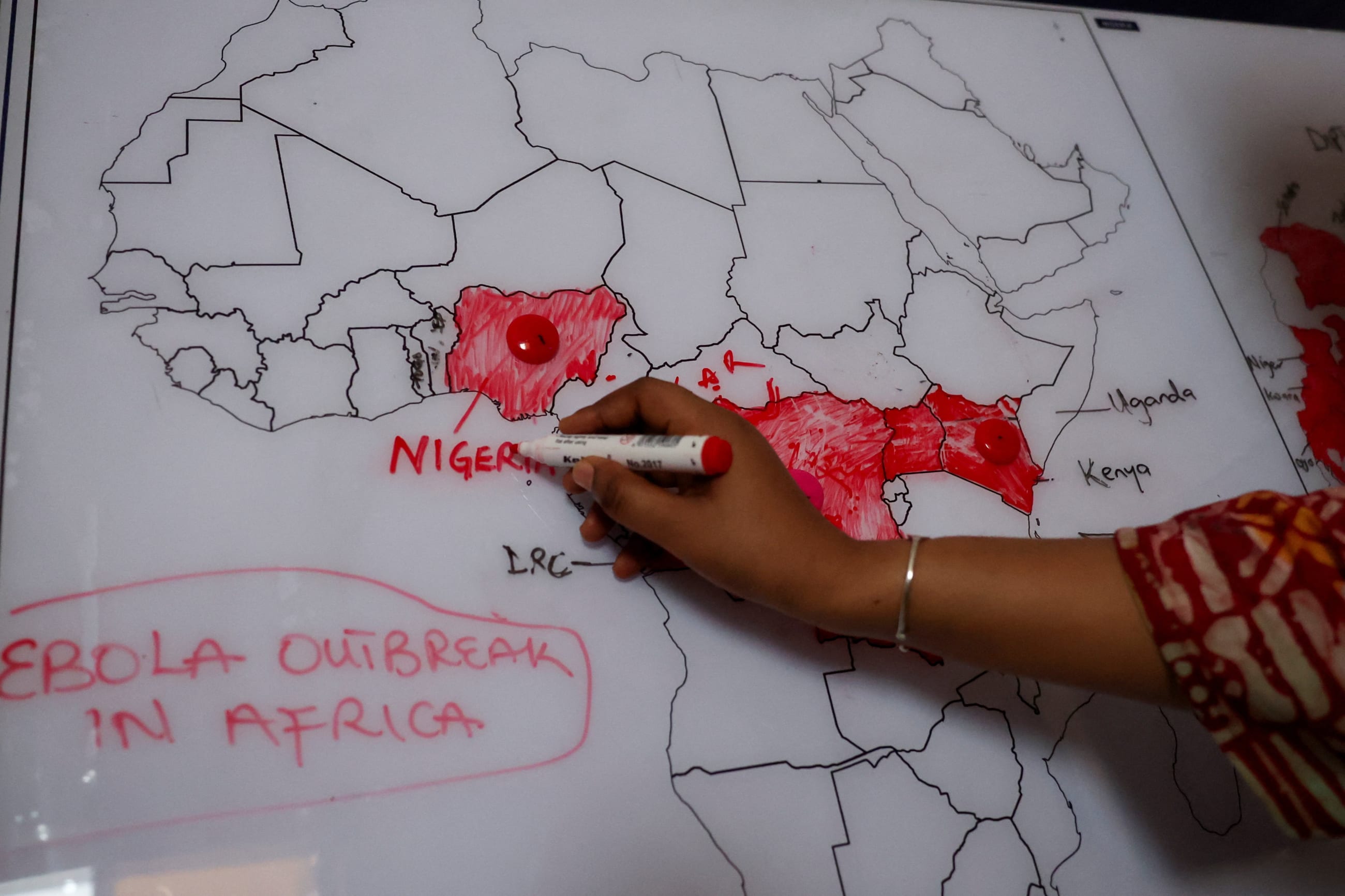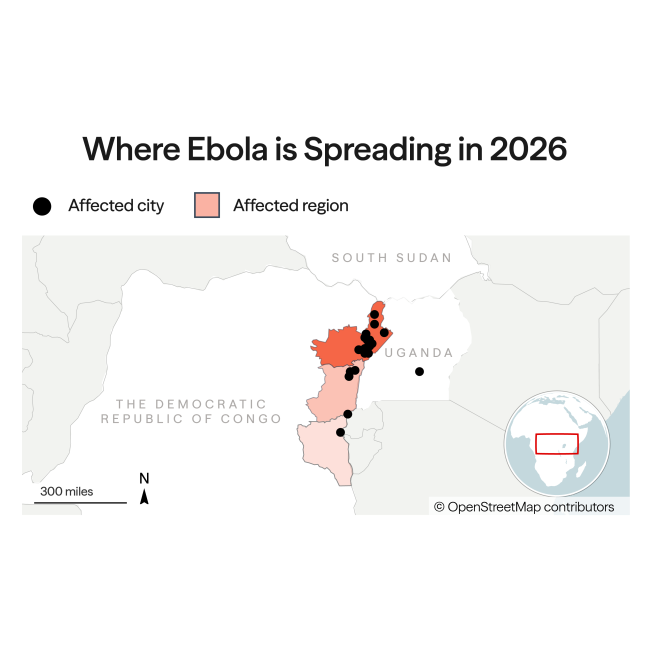
Last month, the Ebola Bundibugyo virus was exported from its epicenter in the Democratic Republic of Congo (DRC) to Kenya, and then to Nigeria. Luckily, both Kenya and Nigeria have since been able to contain the virus.
Meanwhile, the Ebola outbreak continues, with a total 11,762 confirmed cases and 5,775 related deaths in DRC as of November 20, 2026. There is still no licensed vaccine or treatment for the Bundibugyo strain, although there is an ongoing trial of vaccine candidates in Bunia, DRC. It is not known whether the existing Ebola vaccine for the Ebola Zaire strain, Ervebo, may be protective against the Bundibugyo virus in humans. Early signals from animal and laboratory data suggest that some cross-protection is possible, which has led to calls for release of more doses of the existing vaccine. The DRC Ministry of Health has expanded access to Ervebo through compassionate use mechanisms.
As the outbreak nears the 200-day mark in DRC, catching new transmission early from exported Ebola cases comes down to how quickly and honestly countries share what they know with other governments, and whether countries' leaders had built resilient bonds before the first case arrived. Safeguarding Africa's health security hinges on strengthening relationships, communication, and trust between countries.
Nigeria's Ebola Case Illustrates the Importance of Building Trust Across Borders Before Emergencies Arise
Every disease outbreak begins with an index case and a race against the clock, and can test trust between countries, as the events surrounding Nigeria's diagnosis of an Ebola case for the first time in 12 years demonstrate. The Nigeria Ebola index case—a woman who had visited Uganda—returned to Abuja on October 3, 2026, became symptomatic on October 7, and was ill for nearly two weeks before confirmatory testing was done on October 20. Revelations about her travel history prompted her Ebola testing.
Such an effective response requires countries working together with trust and an eye on the big picture to stop the ongoing outbreak
When Nigerian authorities publicly linked the woman's Ebola infection to Uganda, it prompted swift pushback from Ugandan authorities. The Ugandan government disputed that the woman was infected in Uganda pending the release of full epidemiological and travel facts. Before the diplomatic argument could get out of hand, epidemiological and genomics data was quickly assembled by authorities in Kenya and Nigeria and by the Africa Centres for Disease Control and Prevention (Africa CDC). The data revealed that the situation was more complex than originally thought: the woman diagnosed with Ebola in Nigeria had likely crossed paths in the Ugandan airport with an infected man who was traveling from DRC to Kenya. The man later died from the virus in Kenya. The data compiled by Africa CDC, Kenya, and Nigeria also confirmed that the virus samples obtained from the man and woman were related to each other and to the wider DRC outbreak.
The miscommunication between Nigeria and Uganda could have been averted if national public health leads had met to share epidemiological facts and coordinate messaging first, even while acknowledging countries' sovereignty. The Nigerian case has since recovered, and all 62 contacts completed 21-day monitoring on November 13, 2026. No secondary transmission occurred in the country, and the 42-day countdown toward an official Ebola-free declaration is running, with a provisional Ebola-free date as early as December 7, 2026.
This was an example of cross-border outbreak response working as intended, despite the initial confusion. Such an effective response requires countries working together with trust and an eye on the big picture to stop the ongoing outbreak.
Ways to Strengthen Trust Across Borders
Moving forward, a variety of tactics exist that African countries can use to boost trust across borders. When I worked as the director of the Nigeria CDC, I found it useful to belong to various organizations: West African National Public Health Institutes (NPHIs) convened by the West African Health Organization, which still has a standing WhatsApp group; the Africa CDC NPHI initiative; the International Association of National Public Health Institutes (IANPHI), and so forth. These relationships are important because speedy outbreak response is best delivered by building on existing formal and informal communication channels between a country's own national and subnational authorities and domestic financing earmarked for this purpose.
The public health community can also learn how to improve health security from the animal sector, which I believe is doing better than its human health counterpart. Our animal health colleagues had regular communication with their partners across the border and in the region.
Nigeria has a well-established One Health approach—or recognition that human health is closely linked to the health of animals and the environment we share—led by the NCDC during my time there. When anthrax-infected animals crossed the border ahead of a religious feast, advance warning reached me as NCDC director general through established channels and relationships, not via a cold call. When anthrax was subsequently confirmed in animals in Nigeria, the human and animal sectors jointly coordinated the outbreak response.
Weaknesses in Cross-Border Health Security
Gaps in cross-border health security persist despite the WHO IHR framework that requires reporting within 24 hours of an event that has potential for international spread. The Africa CDC guidance has a similar provision. The importation of Ebola from DRC to Kenya and Nigeria shows that travelers who have symptoms or are in the incubation period can pass through borders and major transit hubs without detection.
The interventions required to improve disease detection are standardized point-of-entry screening and mobility mapping with data, including immediate sharing of passenger manifests and harmonized protocols for cross-border contact tracing. When health security systems work as they should, the window between detection and action is shortened because passenger lists are shared in hours instead of days, and exposed travelers are appropriately screened and tracked across borders. Ultimately, an imported case is identified and isolated before a local outbreak ensues. I recommend that national and cross-border public health authorities invest in establishing this cooperation before the suspect case's arrival, working with WHO, the Africa CDC, and regional entities like WAHO.
For the next Ebola case or other outbreak, a key determinant of the response's success will be how well communication channels, supporting financing, and cross-border trust functioned in peacetime before a health emergency situation. These principles align with the African Ubuntu philosophy, which has an appreciation for human interconnectedness, shared responsibility, empathy, and community harmony.